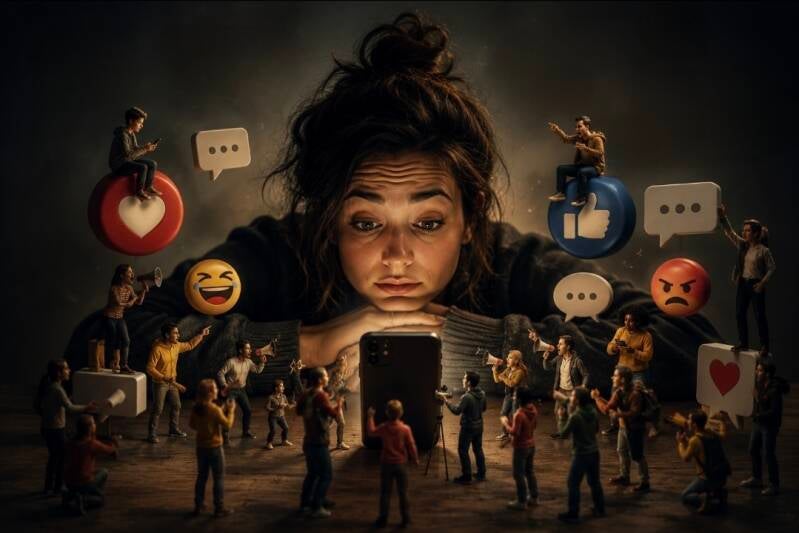
The longer I spend on social media, the more I find myself sitting back and wondering how our species has managed to survive this long.
Don't get me wrong. Social media has connected me with incredible people. I've learned things I never would have otherwise learned. I've met friends, built communities, and had conversations with people from all over the world. But it has also become one of the greatest anthropological studies of human behaviour ever created, and honestly, if aliens are watching us, they're probably taking notes on what not to do.
One of the first things social media taught me is that everyone is an expert. Not some people. Not people who have spent years studying a topic. Everyone.
It doesn't matter what the subject is. Indigenous identity, medicine, parenting, politics, mental health, climate change, economics, addiction, history, relationships, or whether pineapple belongs on pizza. Every comment section is filled with people who possess an unwavering confidence that would make seasoned professionals question their own credentials.
I've always been fascinated by that. When I was younger, I assumed confidence came from knowledge. Social media taught me that confidence often arrives long before knowledge does and occasionally never bothers waiting for it to catch up.
It has also taught me that reading is apparently optional.
Every day I watch people passionately debate articles they have clearly never opened. A headline gets posted, and within minutes hundreds of people have formed deeply entrenched opinions about content they haven't actually read. The article itself becomes almost irrelevant. The headline is simply a starting pistol for a race toward outrage.
I sometimes imagine journalists spending hours researching and writing a thoughtful piece only to watch the comments fill up with people arguing about something completely unrelated. The article could be about migratory birds and by the fifth comment someone is blaming Trudeau, somebody else is blaming capitalism, and a third person is somehow connecting it to the fall of the Roman Empire.
What fascinates me most, though, is how quickly nuance disappeared from public conversation.
Maybe it's still out there somewhere. Maybe nuance is living on a beach in Mexico, sipping margaritas and enjoying retirement. If so, good for her. She earned it.
Because online, everything seems to exist at the furthest possible extremes. Something is either the greatest achievement in human history or an unforgivable act of evil. There is no room for "it's complicated" anymore. There is no room for context, complexity, or acknowledging that multiple things can be true at the same time.
I've watched people argue against positions nobody actually holds. I've watched people agree with each other while somehow remaining locked in a heated argument. Entire comment sections unfold like two people standing back-to-back swinging wildly at imaginary opponents.
And speaking of arguments, social media has taught me that human beings will argue about absolutely anything.
I mean anything.
Given enough time, people could start a war over a sandwich.
Not whether it tastes good. That's amateur hour. They would argue about whether it's really a sandwich, whether the sandwich is offensive, whether sandwiches have become too political, whether their grandmother made better sandwiches, and whether people who enjoy that particular sandwich are personally responsible for the collapse of Western civilization.
By day three there would be reaction videos, think pieces, petitions, and at least one person announcing they are leaving the internet forever because of the sandwich discourse.
They would, of course, return two days later.
Another thing social media has taught me is that people claim they want authenticity right up until they encounter it.
Everyone says they want real people. They want honesty. They want transparency. They want someone willing to speak openly and say what they think.
What they often mean is that they want authenticity as long as it's comfortable, familiar, and doesn't challenge anything they already believe.
The moment someone speaks honestly about a difficult experience, shares an unpopular opinion, or refuses to fit neatly into a category, the interrogation begins. Suddenly there are questions, accusations, demands for credentials, proof, receipts, documentation, references, blood samples, and possibly a signed affidavit from your ancestors.
As someone who spends a lot of time discussing Indigenous issues online, I've discovered there is no faster way to attract self-appointed experts than simply existing in public. It's remarkable, really. Complete strangers will confidently explain your own experiences to you despite having learned of your existence approximately seven minutes earlier.
The confidence remains impressive.
The accuracy, less so.
Yet for all of the absurdity, all of the arguing, all of the misinformation, all of the performative outrage and professional comment-section warriors, social media has also taught me something surprisingly hopeful.
Most people are looking for the same thing.
Connection.
Belonging.
Recognition.
They want to feel seen. They want to feel heard. They want to know they matter. Sometimes they go about it in strange ways. Sometimes they express it through anger, certainty, or endless debates about things that don't actually matter. But underneath all of it is a very human desire to be understood.
Humans, I've learned, are messy creatures. We are contradictory, emotional, overconfident, sensitive, stubborn, brilliant, exhausting, hilarious, and occasionally incapable of reading beyond a headline.
And despite everything I've witnessed online, I still find us fascinating.
Although if social media has taught me one final lesson, it's this: somewhere beneath this blog, or in my private messages, there is almost certainly someone preparing to argue with a point I never made after reading only the title.
Have the day you deserve. ✌️
🥰🫖 𝒥ℛ𝒯
Add comment
Comments