I've been spending a lot of time on social media lately, which is probably my first mistake.
The longer I stay there, the more I find myself wondering when exactly we decided that being human requires supporting documentation.
At some point, simply existing stopped being enough.
Now, before you're allowed to have an opinion, share an experience, tell your story, attend an event, participate in a conversation, or occasionally mind your own business, you're expected to provide proof.
Not just a little proof, either.
We're talking a full application package.
A family tree.
Three references.
Two pieces of government-issued identification.
A DNA sample.
Possibly a blood oath.
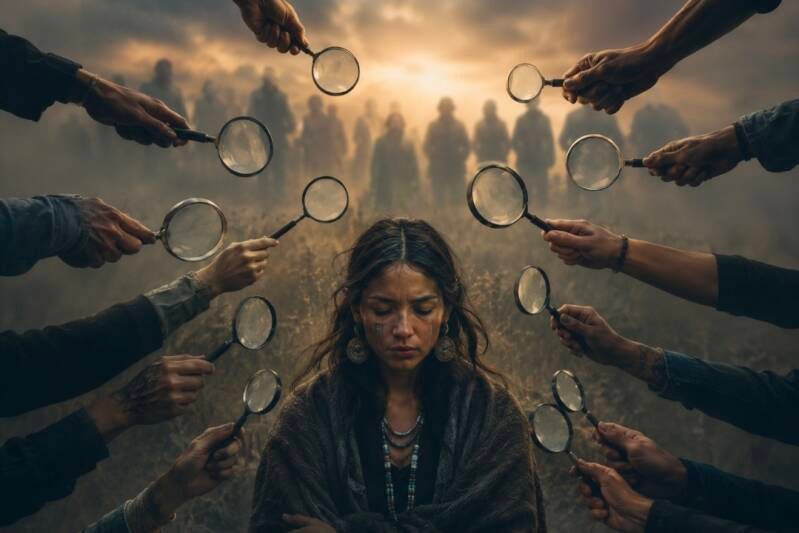
And if you're Indigenous, don't forget your status card, community connections, clan information, family history, cultural practices, and a detailed explanation of how many generations back your ancestors were Indigenous enough to satisfy the random stranger currently auditing your existence.
It's fascinating, really.
We've somehow created a culture where everyone demands credentials before they'll acknowledge another person's humanity.
And the irony is that most of the people conducting the interrogations weren't appointed to the position.
They just showed up one day and declared themselves Chairperson of the Committee for Determining Whether Other People Are Legitimate.
The Indigenous community isn't immune to this.
In fact, lately it feels like we're exceptionally good at it.
Every day I watch people accuse complete strangers of being "pretendians" because they don't have status, don't know their clan, don't know their community, weren't raised traditionally, don't look Indigenous enough, do look Indigenous but have European ancestry, were disconnected from culture, or are reconnecting in a way someone else doesn't approve of.
The goalposts move so often I'm surprised nobody has pulled a hamstring.
And before anyone starts clutching their smudge bowls, yes, there are people who intentionally misrepresent themselves. That's a real issue.
But somewhere along the way we stopped addressing actual fraud and started treating every Indigenous person like they're arriving at the border carrying counterfeit identity documents.
The reality is that colonization disconnected families.
Residential schools disconnected families.
The Sixties Scoop disconnected families.
Generations of shame, discrimination, and survival disconnected families.
Then some people turn around and demand perfect records for the very things that were intentionally taken from us.
That's like setting someone's house on fire and then criticizing them for not producing the original floor plans.
Make it make sense.
Of course, this isn't just about Indigenous identity.
It's everywhere.
Mothers can't simply be mothers anymore.
Every parenting decision has become a public consultation process.
If you work, you're neglecting your kids.
If you stay home, you're setting feminism back fifty years.
If your children eat processed food, you're poisoning them.
If you make everything from scratch, you're somehow privileged and out of touch.
You can spend twenty three years loving your children with every ounce of your being, and someone online will still conclude you're ruining their future because you bought Fruit Loops.
Trauma works the same way now.
People don't just share experiences anymore.
They submit them for review.
Someone says they're struggling and within minutes a panel of strangers appears to explain why their suffering isn't severe enough, wasn't recent enough, wasn't traumatic enough, or doesn't compare to someone else's.
We've turned healing into a competition and pain into a ranking system.
Congratulations, I guess.
Your trauma won.
Would you like a trophy?
Education gets the same treatment.
Experience gets the same treatment.
Success gets the same treatment.
You can spend years studying a subject, building a career, gaining expertise, and someone whose profile picture is a pickup truck photographed from twelve different angles will confidently explain why you're wrong.
Not because they know more.
Because confidence has somehow become a substitute for knowledge.
It's honestly one of the most impressive magic tricks of the internet.
The less people know, the more certain they seem to become.
What concerns me most isn't the disagreement.
Disagreement is healthy.
Questions are healthy.
Curiosity is healthy.
What's becoming unhealthy is this growing belief that people must constantly defend their right to exist.
Prove you're Indigenous enough.
Prove you're qualified enough.
Prove you're healed enough.
Prove you're traumatized enough.
Prove you're successful enough.
Prove you're struggling enough.
Prove you're a good enough parent.
Prove you're a good enough woman.
Prove you're a good enough human being.
We're becoming so obsessed with verification that we've forgotten something incredibly simple.
Most people are just trying to get through the day.
Most people are carrying stories we know nothing about.
Most people don't owe strangers a complete biography before they're allowed to speak.
Not every conversation is a courtroom.
Not every opinion requires a credentials check.
Not every life experience needs to be peer-reviewed before it's considered valid.
Sometimes a person is exactly who they say they are.
Sometimes a story is simply a story.
Sometimes another human being deserves to be heard without first being cross-examined by the Internet Bureau of Investigation.
Maybe that's the part I miss most.
The humanity.
The ability to sit across from someone, hear their story, and resist the urge to immediately demand evidence.
Because somewhere between social media, outrage culture, and everyone's desperate need to be the smartest person in the room, we've forgotten how to simply let people exist.
And honestly?
I think that's a much bigger problem than whether somebody can prove who they are.
The question isn't why people are tired of defending themselves.
The question is why we've become so comfortable demanding a defence in the first place.
🥰🫖𝒥𝓊𝓈𝓉ℛℯ𝒶𝓁𝒯ℯ𝒶
Add comment
Comments